I was looking at a book published by a local church that my wife and I visited recently. The book explained the doctrines held by that local body. What struck me was how the book used the term “sacraments”.
In another search, I found a book that discussed how people are increasingly “drawn” to the Anglican Liturgy (which is the formal style and rituals of that denomination – with its many “sacraments”).
Much of this rising interest in the traditional, liturgical churches stems from a desire many have to return to the outward feelings experienced in these church environments. Experiences that include worship services with candles, a beautiful sanctuary, quieter music, stained glass windows, clergy in robes, no drum and electric guitar setup on stage, and the use of old hymnals instead of jumbotrons.
This old style of things is something I’m very familiar with. Having grown up in a traditional Methodist church with a much quieter and more formal style.
Which, by the way, has its appeal. And, IF the UMC had actually preached the gospel and stood on the fundamentals of the faith, I’d still be there.
What is disturbing about all this is how Evangelicalism has jettisoned most of the Traditional stuff in favor of the “Contemporary”. Even as so many other religious groups are going back to the traditional rituals and the “contemplative” religious atmosphere.
This also correlates with what I experienced during a recent liturgical funeral at an ELCA church.
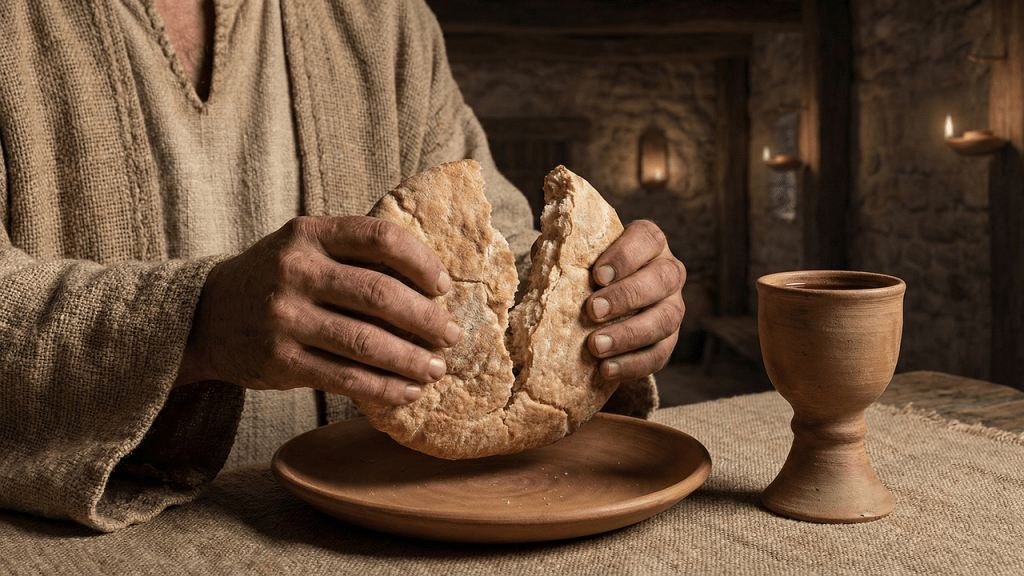
During that funeral, the “priest” explained their church’s belief in “the presence of Christ in the wine and the bread”. In other words, I witnessed the “sacrament” of the “Eucharist” practiced in a supposedly Protestant church.
According to this ritual, the wine became, according to their beliefs, literally transformed into the physical blood of Christ. And the wafer or bread was also supposedly transformed into the physical body of Christ.
I generally expect to see these types of beliefs in the mainline apostate denominations. That is par for the course.
But the fuzziness in teaching, relating to the ordinance of the Lord’s Table (Communion), has been spreading rapidly across the Evangelical landscape.
This is because Evangelical pastors and teachers have become increasingly unclear about these “sacraments”. This confusion occurs as leaders have chosen to be vague about the differences between “ordinances” and “sacraments”.
Confusion in the Language
In other words, there is a common thread of compromise that runs throughout many popular church groups regarding the “sacraments”. This is a form of spiritual compromise that encourages people to take comfort in the supposed “effectiveness” of “sacraments” – which are said to provide forgiveness, cleansing, peace, and even salvation.
Evangelical leaders are encouraging people to take part in these practices that are directly contradictory to the gospel of Christ.
This confusion has been caused by leaders who have purposefully adopted the same language used by false “Christian” religions – so that Evangelicals might appear more inclusive and tolerant.
This confusion is accomplished by subtly changing the clear meaning of biblical words and phrases to appease those who do not believe the gospel. To avoid offending those people.
Which cuts straight to the core of how far Evangelicalism has fallen away from truth over the last 100 years.
Lack of Clarity Equals Spiritual Disobedience to God’s Word
This intentional lack of clarity has been designed to promote harmony, dialogue, and warm fellowship with those religious groups who practice “other Christian Traditions” or who even hold to “other” religious doctrines.
And to avoid clearly identifying or singling out false teachers or false doctrines.
And yet, the Bible commands us to do the opposite! To “mark them” whose unbiblical doctrines bring division in the church. Warning us Not to seek unity and fellowship with them. And to even rebuke them.
“Now I beseech you, brethren, mark them which cause divisions and offenses contrary to the doctrine which ye have learned; and avoid them.“ (Romans 16:17)
Instead, many modern Evangelical leaders seek to make “common cause” with apostate groups and leaders. Joining together with them in all kinds of social engagement projects and initiatives. Much of that work is categorized as missional work today.
All done in order to “win them to Christ” – over time – while working “alongside” them – with the idea that a believer’s proximity to these false religious leaders will eventually provide an opportunity to “witness” to them.
Which is essentially to follow the methods of Satan in order to win the lost! To employ pragmatic, carnal means to do the work of the Holy Spirit.
By minimizing truth while elevating good works.
By making clever use of the term “sacraments” instead of clearly teaching about the ordinances of the Lord’s Table and Baptism.
Creating confusion among both Christians and unbelievers.
To Be Continued …
Image by Vesa Leppänen from Pixabay


Leave a Reply